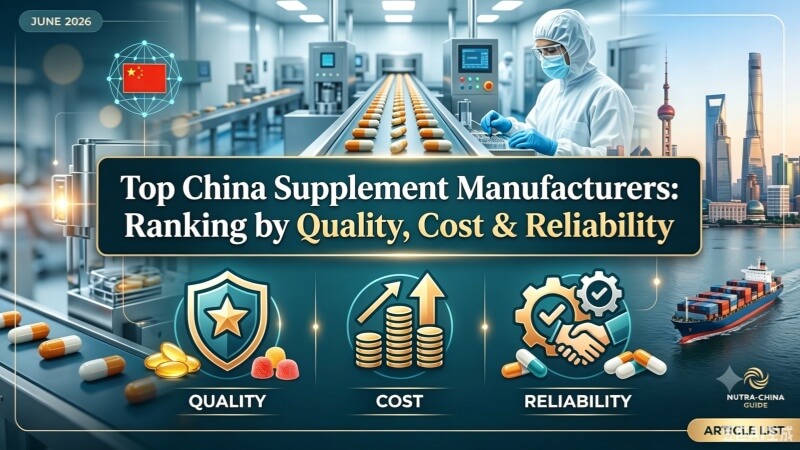
Top China Supplement Manufacturers 2026: Ranking by Quality, Cost & Reliability
Introduction: Why Choosing the Right Manufacturer Matters
China plays a central role in the global nutraceutical supply chain, with a large share of dietary supplements, vitamins, softgels, gummies, capsules, and powders manufactured in the region.
However, for international brands, choosing the right China supplement manufacturer is often more challenging than expected.
Common risks include:
-
Product quality inconsistency between batches
-
Delays in production and shipment cycles
-
Lack of transparency in raw material sourcing
-
MOQ requirements that exceed early-stage demand
-
Communication gaps across time zones and languages
In many cases, the issue is not the absence of manufacturers, but the lack of a structured evaluation framework.
This guide provides a practical, industry-based framework to evaluate China supplement manufacturers across three key dimensions:
Quality · Cost · Reliability
1. Main Types of China Supplement Manufacturers
The supplement manufacturing industry in China can generally be divided into three categories:
1.1 Mega-Scale Integrated Manufacturers
Example:
Sirio Pharma
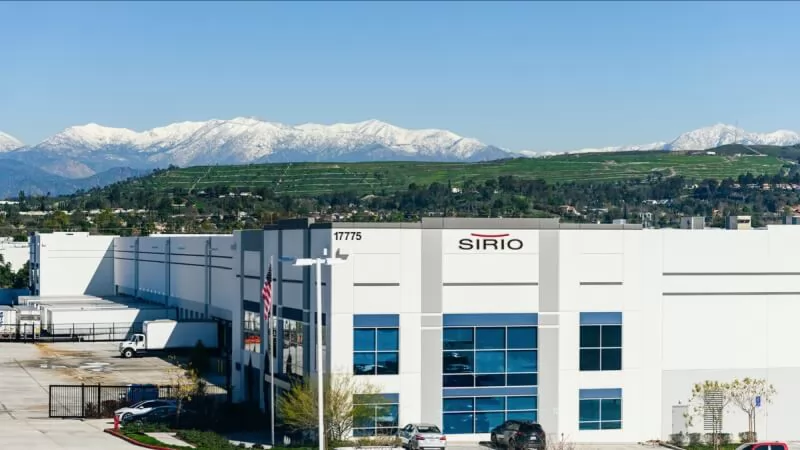
These companies typically operate at a global industrial scale with extensive production capacity and certifications.
Characteristics:
-
Very high production capacity
-
Extensive global certifications
-
Strong compliance systems
-
Higher MOQ requirements
Best suited for:
-
Large multinational brands
-
High-volume global product lines
-
Established supplement companies
1.2 OEM/ODM Specialized Manufacturers (Balanced Model)
Example:
Wright Life Nutrition
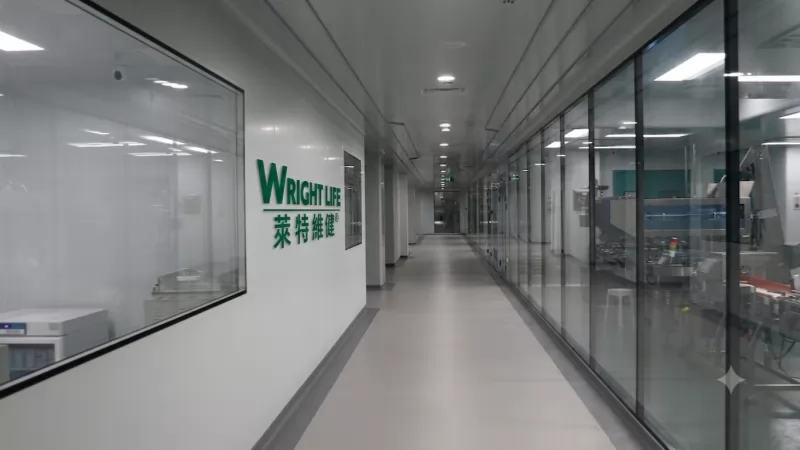
OEM/ODM-focused manufacturers specialize in contract manufacturing rather than building their own consumer brands.
Characteristics:
-
Focus on private label manufacturing
-
Faster product development cycles
-
Flexible formulation support
-
Medium-scale production capability
Best suited for:
-
DTC supplement brands
-
Amazon sellers
-
Growth-stage companies
-
Brands requiring product iteration speed
1.3 Cost-Focused Contract Manufacturers
Examples:
LJY Nutrition
ZoomsHeal Health
These manufacturers typically compete on price and scale efficiency.
Characteristics:
-
Lower production cost
-
High-volume efficiency
-
Standardized production processes
-
Limited customization flexibility
Best suited for:
-
Price-sensitive brands
-
Large standardized SKUs
-
Commodity supplement products
1.4 Stability-Focused Legacy Manufacturers
Example:
TCI Bio
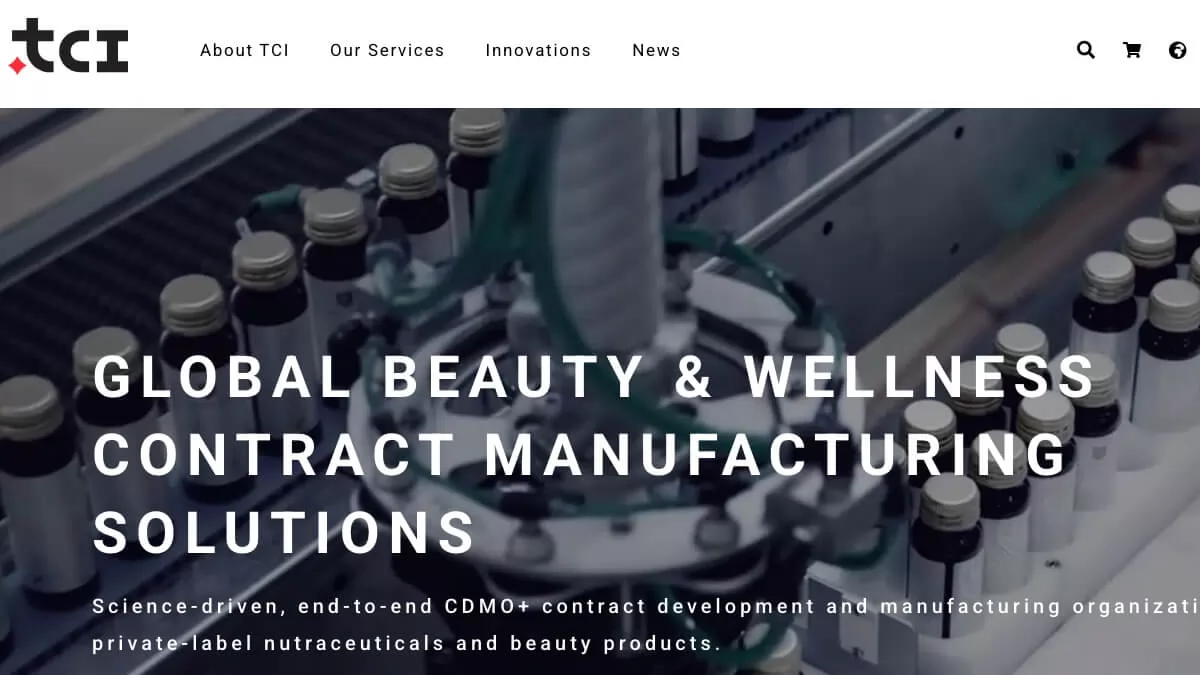
These companies emphasize long-term supply chain stability and established industry relationships.
Characteristics:
-
Long operational history
-
Strong compliance background
-
Stable supply chains
-
Slower innovation cycles
2. Quality Evaluation Framework (Critical Factor)
When evaluating supplement manufacturers in China, quality should be assessed beyond certifications.
2.1 Raw Material Control
High-quality manufacturers typically:
-
Use limited, audited raw material suppliers (2–5 core suppliers)
-
Maintain full traceability from origin to finished product
-
Require COA (Certificate of Analysis) for every batch
Lower-tier manufacturers often:
-
Switch suppliers frequently for cost optimization
-
Lack consistent traceability systems
2.2 Testing & Quality Control System
A complete quality system includes:
-
Incoming raw material testing (HPLC, heavy metals, microbial screening)
-
In-process quality checks (blend uniformity, weight control)
-
Final product verification (active ingredient accuracy, stability testing)
Tier 1 manufacturers generally maintain:
-
Defect rate: <1–2%
-
Multi-stage testing systems
-
Third-party verification options
2.3 Certifications (Baseline Requirement)
Common certifications include:
-
GMP (Good Manufacturing Practice)
-
ISO 9001 Quality Management
-
FSSC 22000 Food Safety System Certification
-
FDA facility registration (for export markets)
3. Cost Structure Understanding
Supplement pricing in China typically includes:
Cost Component Range
Raw materials 40–55%
Manufacturing 10–18%
Quality testing 1–5%
Overhead 10–25%
Profit margin 10–20%
Key Insight
Lower price does not always equal lower total cost.
Low-cost manufacturers may reduce expenses by:
-
Skipping stability testing
-
Using lower-grade raw materials
-
Reducing quality control frequency
This can lead to:
-
Product recalls
-
Brand reputation risk
-
Higher long-term replacement costs
4. Reliability: The Most Overlooked Factor
Reliability determines long-term manufacturing success more than price or certifications.
4.1 Communication & Response Time
Level Response Time Communication Model
Tier 1 <4–24 hours Dedicated account manager
Tier 2 1–2 days Shared contact
Tier 3 >2 days Inconsistent communication
4.2 Production Stability
Reliable manufacturers typically offer:
-
Accurate lead time estimation
-
Transparent delay communication
-
Multi-line production redundancy
-
Stable long-term capacity allocation
4.3 Long-Term Partnership Capability
Strong manufacturers often provide:
-
Multi-year pricing stability
-
R&D collaboration support
-
Product optimization suggestions
-
SKU expansion assistance
5. Comparative Overview of Major China Supplement Manufacturers
Manufacturer Scale Cost Flexibility Innovation Best For
Sirio Pharma Very High High Low Medium Global brands
Wright Life Nutrition Medium Medium High High Growth brands
LJY Nutrition Very High Low Medium Medium Mass production
TCI Bio High Medium-High Medium Low Stable supply
ZoomsHeal Health Medium Low High Medium Startups
6. How to Choose the Right Manufacturer (Decision Framework)
Step 1: Define Your Business Stage
-
Startup → prioritize flexibility + MOQ
-
Growth-stage → balance cost + innovation
-
Enterprise → prioritize compliance + scale
Step 2: Define Production Requirements
-
Annual volume
-
Number of SKUs
-
Product formats (capsules, gummies, powders, softgels)
Step 3: Evaluate Quality Depth
Ask manufacturers:
-
How many raw material suppliers do you use?
-
What is your defect rate?
-
Do you offer third-party testing?
Step 4: Evaluate Communication Speed
Test:
-
Initial response time
-
Technical clarity
-
Willingness to optimize formulas
Step 5: Assess Long-Term Stability
Look for:
-
2–5 year client relationships
-
Multi-market export experience
-
Consistent production records
Conclusion
Selecting a China supplement manufacturer requires evaluating three core pillars:
Quality + Cost + Reliability
Each manufacturer type serves a different stage of business development:
-
Mega-scale factories → global volume brands
-
OEM/ODM specialists → growth-stage brands
-
Low-cost manufacturers → commodity production
-
CDMO legacy firms → long-term stability
For most emerging and growth-stage supplement brands, the optimal balance lies in OEM/ODM manufacturers that combine flexibility with controlled quality systems.
0
Comments
Leave a Comment
Your email address will not be published. Required fields are marked *
Name can't be empty
Email error!
Message can't be empty
😍
😜
😳
😌
😄
😘
😝
😒
😃
😚
😚
😛
😟
😧
😀
😉
😓
😱
😤
😣
😂
😥
😩
😠
😢
😭
😰
😨
😡
😆
😪
😅
😐
😇
😋
😴
👿
😕
😏
😷
😵
😟
😮
😯
😑
👧
👴
😧
😬
😾
👶
👱
👵
👸
🙀
👺
👦
👩
👨
😽
😿
🙈
💩
💥
💤
😼
😹
🙉
🔥
✨
💦
👎
✌
👆
👈
💪
💹
👍
👊
💴
💶
💷
💸
👉
💵
🙏
🌎
🏧
👏
💳
👇
💑
🙆
🙅
💁
👫
👭
🙎
🙇
👑
👔
Submit Comment
Most Popular
-
 Aug 19, 2026Top 10 Private Label Supplement Manufacturers in the USA (2026 Guide)
 -
 Jun 28, 2026Top China Supplement Manufacturers 2026: Ranking by Quality, Cost & Reliability
 -
 Jul 13, 2026Top 10 Private Label Softgel Manufacturers: The Ultimate Guide for Supplement Brands
 -
 Jul 22, 2026Top 10 softgel manufacturer in USA(2026 Guide)


Laster Blogs
-
 Sep 11, 2026CoQ10 Softgel Manufacturing Guide: Formulation, Bulk Production, Wholesale and Manufacturer Selection
 -
 Sep 11, 2026Top 10 Organic Capsule Manufacturers for Supplement Brands in 2026
 -
 Sep 09, 2026Oregano Oil Softgel Manufacturing Guide: Formulation, OEM Production, Bulk Supply and Manufacturer Selection
 -
 Sep 09, 2026Health Industry Technology Innovation Excellence Award Ceremony


Set A Consultation Today
Name can't be empty
Email error!
Send Your Message
*We respect your confidentiality and all
information are protected.